Die Meistersinger von Nürnberg
At the end of a science PhD I conducted Die Meistersinger in a hall on the Mile End Road — a year learning an opera I didn't know a note of, then four hours in the pit, and still one of the most useful things I've done.
Die Meistersinger von Nürnberg
The production
"…ehrt eure deutschen Meister!" — Honour your German Masters.
As the chorus sang the last phrases and I conducted the last few bars of a project so gigantic that it had scared the shit out of me for all twelve months of rehearsal, I thought: remember this, you will never do anything like this again.
So ended a year of planning, study and rehearsal — twelve months, though it's hard to say when it began in earnest. A final performance, and a pretty good one I think.
We had co-opted design help from architects, lighting from Covent Garden, costumes from English National Opera, technical production from Cambridge Footlights staff. Our artists came from all over: orchestral musicians from the Forest Philharmonic, the Royal College of Music and Queen Mary College; singers from Queen Mary, Islington Green School Choir and the Royal Academy of Music. Wonderful solo artists who had auditioned and then spent nearly twelve months in rehearsal.
How it happened
It wasn't a vanity project. We had no money.
It was something I had thought about from almost the beginning of my time at Queen Mary College. The Great Hall — previously known as the People's Palace, on the Mile End Road — was huge. From the off I thought: Wagner would be great in there.
I went there to read microbiology, allegedly, but spent most of my time on music projects. Everything from Orpheus in the Underworld through to Oh, What a Lovely War! And here I was now, at the end of four years of a science PhD, conducting Meistersinger. Vivian Moses, my supervisor and departmental professor, was in the percussion section having great fun clashing away microseconds too early. Lots of other friends, colleagues, students, admin staff and lab techs were involved.
I had wanted to do Parsifal. I talked to John Ramsden, a history lecturer at Queen Mary — a friend with a passion for music and theatre, and the business and planning head for all this. He said no. He thought Parsifal was a bad idea, too dark. But if we did Meistersinger — allegedly a comedy — he would be all in. I didn't know a note of it. I said yes.
Learning it
I knew some musical support would be helpful. This wasn't just my first Meistersinger, it was my first anything. Howard Williams, the college music director, was a brilliant conductor, musician and teacher, and had been all about supporting students — but he had recently left Queen Mary, and his successor wasn't interested.
In the end my major support was Michael Bauer, who was singing Sachs. He understood the opera totally. He had the perfect voice; Wagner's high baritone writing suited him down to the ground.
For a year I studied the orchestral score, with recordings, every day. Then I began piano rehearsals with the principals. Four and a half hours of music, during which Sachs would be onstage nearly all the time. Mike and I laboured over it. I learned how to be a répétiteur and rehearsed everyone until the point came where I needed to be conducting all the time, and we hired répétiteurs for the last few weeks.
First night
On the first night I walk into the pit. Yes, there is an audience — phew. Then I look at my score on the conductor's desk: a huge thick volume the size of a church bible on a reading lectern. That is volume one, covering Acts One and Two. Volume two covers the two-hour-long Act Three, which is really Acts Three and Four.
The overture
Pick up the baton, look around, smile nervously, take a deep breath, and… wow. We're off.
A loud C major chord sets us going. Each section of the overture has its demands. The orchestra is great — intonation not perfect, but honestly, we'd done it on three orchestral rehearsals. On goes the overture, woodwind takes over, a bit of counterpoint, and then all of a sudden the climax is coming. Remarkable triple counterpoint: three big tunes all playing against each other. Cymbals clash, brass fanfares sound, the final cadence comes into view — and as it does, the massive curtain goes up to reveal a church full of people. The overture ends with a chord from the full organ (yes, that hall has a substantial instrument) and the choir sings the opening chorale.
Tom — my best mate, and my right-hand man through much of this — sings so loudly I can hear his slightly sharp bass above the whole ensemble. He also looks anxious.
It's a scary business.
Through the acts
As the opera continues there are moments of great beauty, fun, terror. Act One ends with disorder in the church as a new knight sings alarmingly and without rules. Act Two ends with a riot, and a nightwatchman who turns up afterwards, spooked by the noise.
Now the first hour of Act Three is over. It's the beautiful heart of the opera, and through-conducting it over the last few weeks has helped me realise that. Now a glorious sextet. We sync the last cadence successfully — huzzah. Then the curtain comes down for a tricky scene change, from a cobbler's hut to a great festival field outdoors with stands and flags. The musical link between the two scenes happens with the curtain down, choruses assembling behind it onstage. Will it go up in time for their opening? What will I do if it doesn't? Sing it myself?
It goes up perfectly, to reveal dancing and singing guildspeople.
Then it's onwards for an hour. Song competition. The prize won — and declined. And then, onstage, Sachs stands up.
Sachs
I know he is terrified. He doesn't look it, but he is.
At the end of the opera our hero, Walther, wins the song competition and the prize (a woman — well, it's Wagner innit). He turns down the privilege of being named a Mastersinger. Sachs, his sponsor, stands up immediately and sings:
Verachtet mir die Meister nicht,
und ehrt mir ihre Kunst!Scorn not the Masters, I bid you,
and honour their art!
This last section is long. Sachs has been onstage for nearly two hours, singing for much of it. Now this long, high, passionate defence of German art — sometimes cut, because of its association with the Nazis.
I know he's anxious. It's high, he's very tired, it's full orchestra. He sings:
Habt Acht! Uns dräuen üble Streich':
zerfällt erst deutsches Volk und Reich…Beware! Evil tricks threaten us:
if the German people and kingdom should one day decay…
I had promised him I would do whatever we needed to get through this last, final, massive aria. So I keep the orchestra down and slowly push up the tempo.
He continues:
Drum sag' ich euch:
ehrt eure deutschen Meister!
Dann bannt ihr gute Geister;
und gebt ihr ihrem Wirken Gunst,
zerging' in Dunst
das heil'ge röm'sche Reich,
uns bliebe gleich
die heil'ge deutsche Kunst!Therefore I say to you:
honour your German Masters,
then you will conjure up good spirits!
And if you favour their endeavours,
even if the Holy Roman Empire
should dissolve in mist,
for us there would yet remain
holy German Art!
At the top of his vocal range, after nearly four hours onstage, Wagner asks him to sing fortissimo and declaim.
The last bars
I don't care how fast we go now, as long as he is supported.
He gets to the end. Successfully. I pull the tempo back as we begin the final chorus, full volume now — Ehrt eure deutschen Meister!
Now, finally, after over four hours, I can relax. The last chorus builds and builds, and an enormous climax brings in the Meistersinger theme with brass fanfares, Vivian on cymbals, and everyone.
I think to myself: this is starting your musical career at the end. Nowhere to go after this.
Wrong, but also true.
Listen
The closing minutes: the final chorus — "Ehrt eure deutschen Meister!" — with the Meistersinger theme coming back in the brass and Vivian Moses on cymbals. Recorded at the final performance, May 1980. From a 50yo cassette tape of the final performance. . Thin on strings, and some intonation that wouldn't survive a modern edit; we'd rehearsed the orchestra three times. It was a good orchestra and this is what they actually did that night.
Photographs
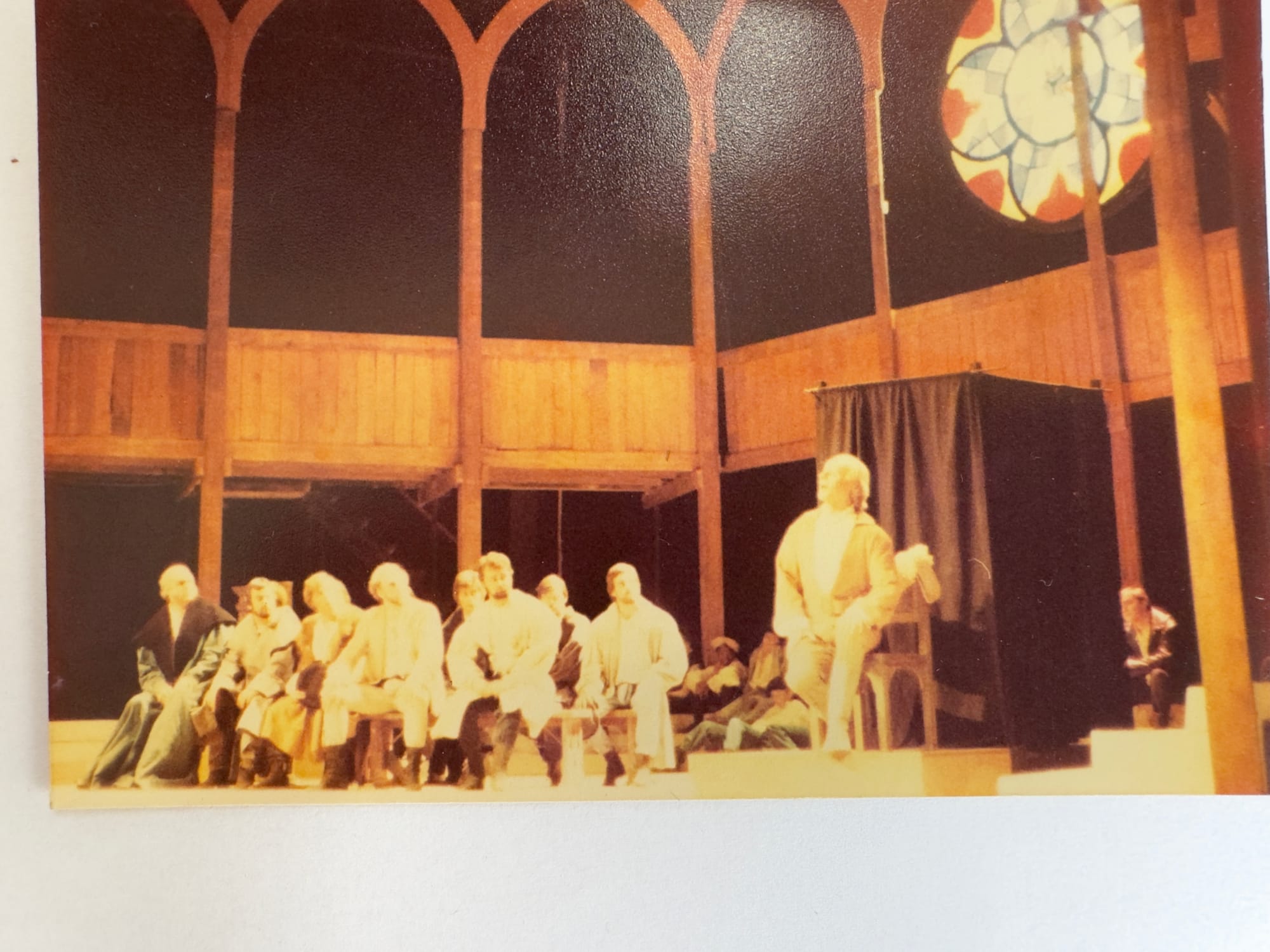
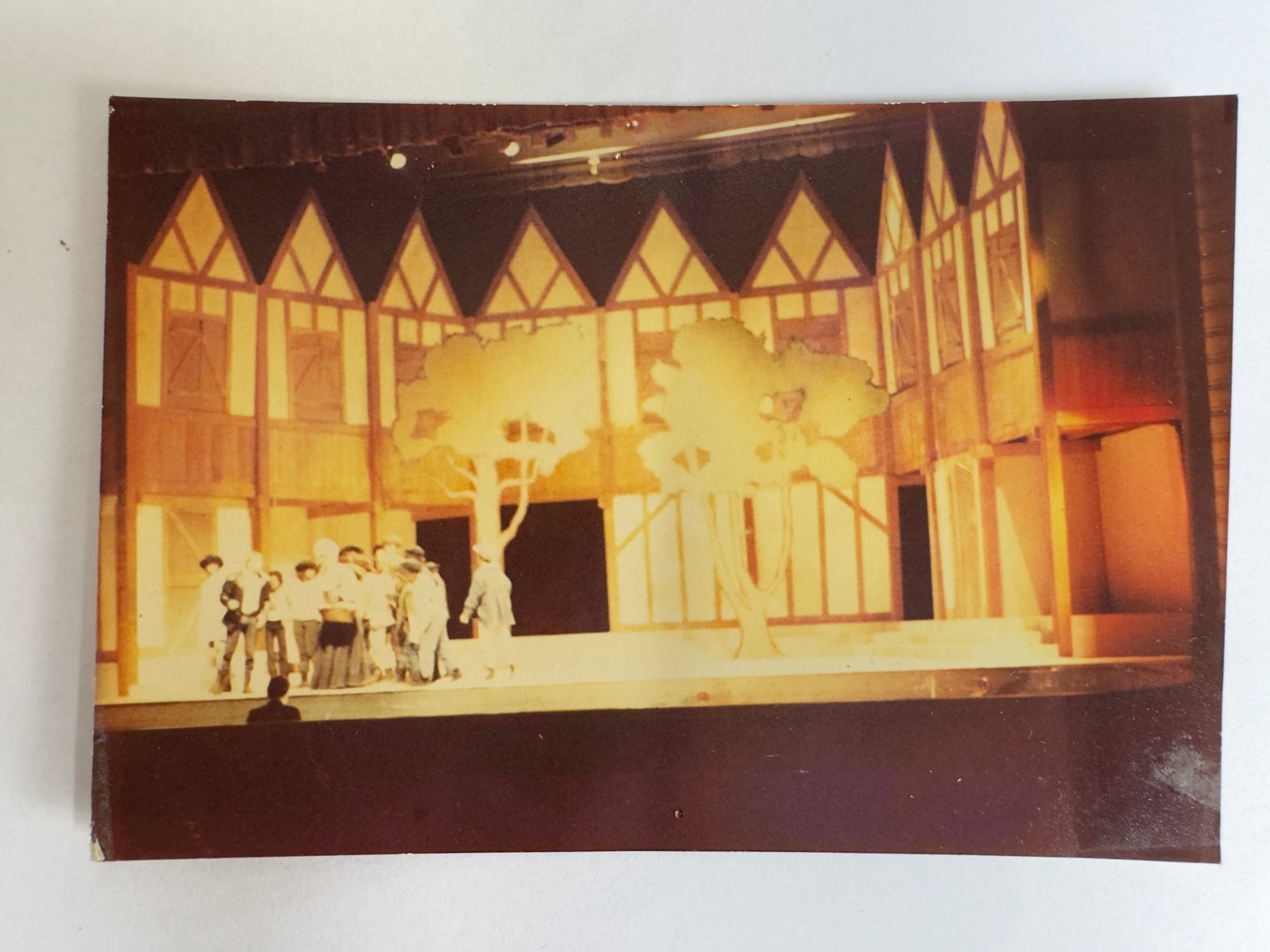
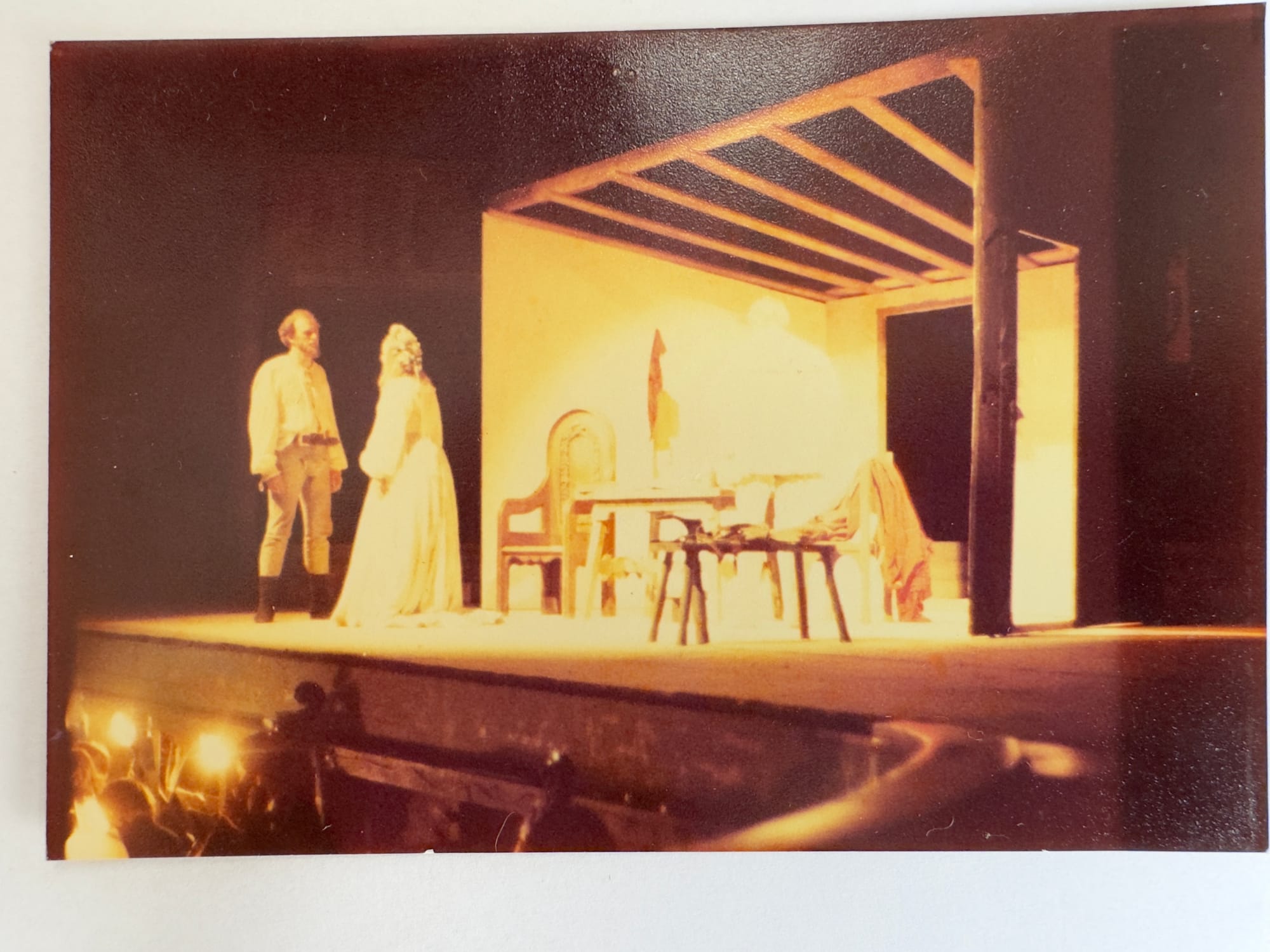
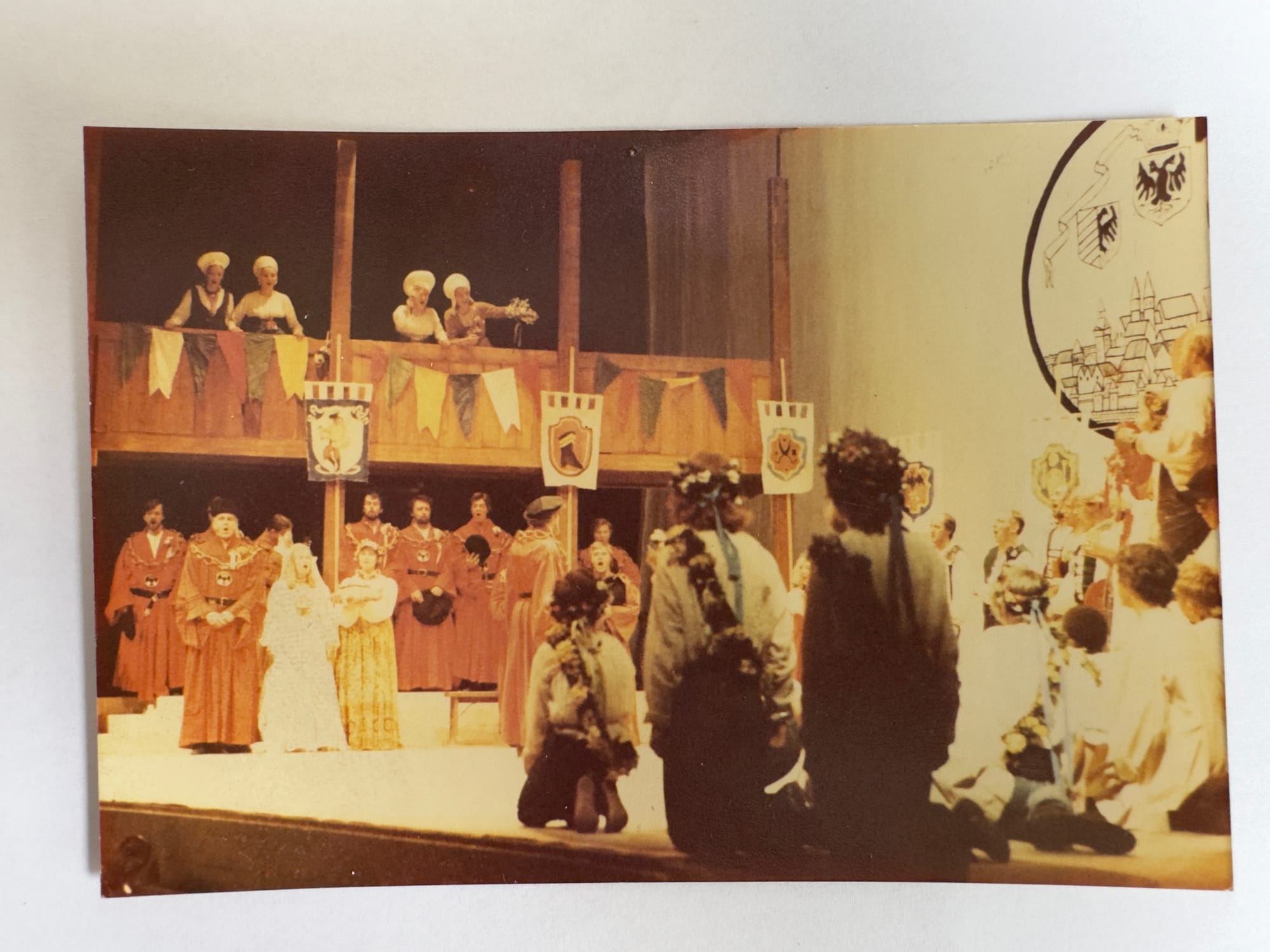
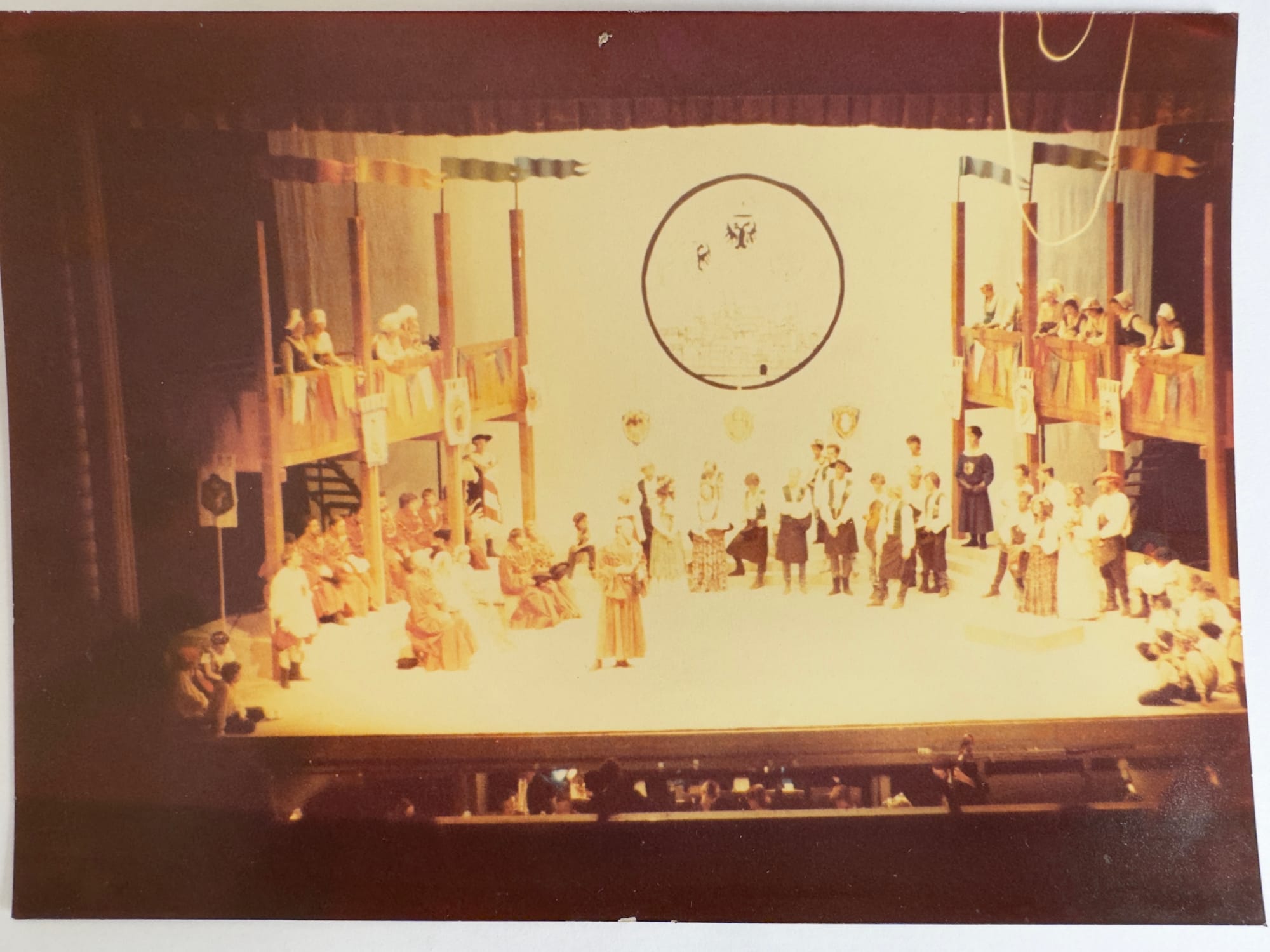
- Walther's trial song. Graeme Matheson-Bruce as Walther and Michael Bauer as Hans Sachs, before the assembled Mastersingers.
- The children's choir.
- In Sachs's workshop. Michael Bauer as Hans Sachs and Kate Rawstron as Eva.
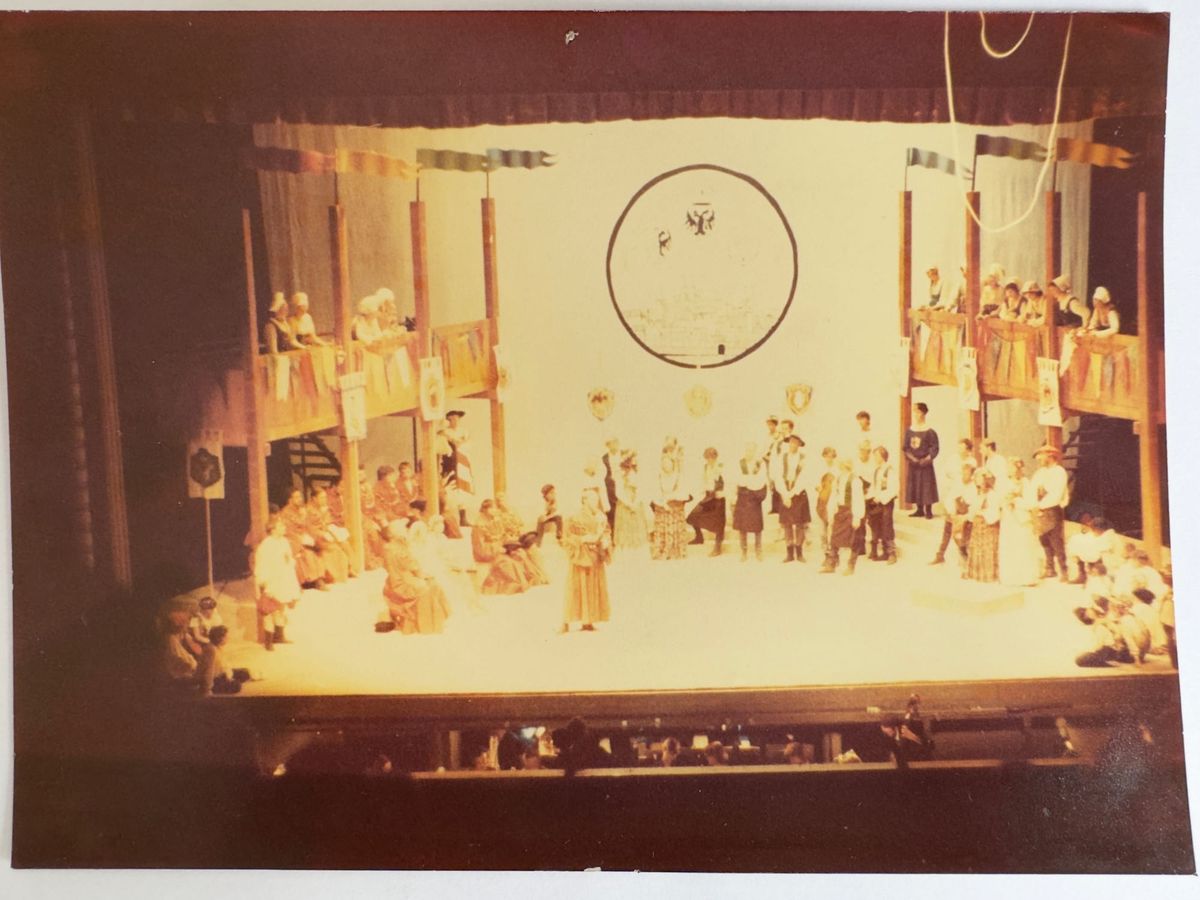
- The Festival Meadow. Kate Rawstron as Eva, Michael Deady as Veit Pogner and Michael Bauer as Hans Sachs, with the chorus.
- The finale. The full company.
Photographer unknown.
Press
"The improbably named East End Opera… embarking blithely upon the grandest of grand operas in the equally unlikely surroundings of the Mile End Road."
— The Times Diary, 8 May 1980
"…the opening C major chords of the Meistersinger overture echoing through the Mile End Road."
— The Times Diary, 8 May 1980
"Wagner can indeed travel east of Aldgate."
— The Times Diary, 8 May 1980
Cast and company
The Mastersingers of Nuremberg
Hans Sachs, shoemaker — Michael Bauer
Veit Pogner, goldsmith — Michael Deady
Sixtus Beckmesser, town clerk — Stephen Williams
Fritz Kothner, baker — Gerard Delrez
Kunz Vogelgesang, furrier — Peter Bronder
Konrad Nachtigall, tinsmith — Daffyd Phillips
Balthasar Zorn, pewterer — Simon Butteris
Ulrich Eisslinger, grocer — Philip Ball
Augustin Moser, tailor — David Kirby-Ashmore
Hermann Ortel, soapboiler — Peter Marshall
Hans Schwarz, stocking-weaver — Nicholas Hardy
Hans Foltz, coppersmith — Geoffrey Dallamore
Niklaus Vogel, vintner — David Carpenter
Walther von Stolzing, a young knight — Graeme Matheson-Bruce
David, Sachs's apprentice — Christopher Adams
Eva, Pogner's daughter — Kate Rawstron
Magdalene, Eva's attendant — Eileen Haines
A Nightwatchman — Geoffrey Dolton
Apprentices: Darren Brady, Wendy Brewer, Lee Briscoe, Adam Carter, Petronella Carter, Lutfy Celul, Nicholas Clapton, Robert Doyley, Richard Gardner, Aaron Graubart, Trudi Gunner, Nicholas Holtham, Marcel Lara, Philip Luke, Ann McElroy, Georgina McElroy, Tabitha Mellor, Robin Moore, Peter Rancom, Peter Roberts, Wilfrid Swansborough, Peter Thorpe, Danny White.
Townspeople: David Adamson, Motoko Aigawa, Fiona Anderson, Ruth Atkinson, Linda Barnes, Sue Barnes, Rita Beaumont, Linda Brotchie, Ian Cooper, Carol Cumber, Anthea Fallen Bailey, Alan Gronner, Pauline Hancock, Peter Harris, Penny Hydrer, Stella Law, Tony Law, Joanne Lynn, William Ormerod, Barbara Page, Maggie Pascoe, Paul Richmond, Julian Sampson, Alan Scott, Nigel Snee, Tom Tate, John Tomkin, David Turner, Ros Turner, Melanie Tye, Ursula Webb, Jane Webster, Diana Williams, Norman Wright, Howard Wynne, Chris Young, David Young.
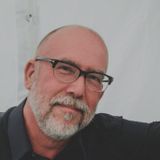
Conductor and musical director — Stuart Ellam
Director — John Ramsden
Chorus master — Timothy Bowers
Boys' chorus master — Philip Luke
Répétiteurs — Sally Popperwell, Julian Sampson
Language coach — Stella Law
Stage manager — Sue Colwell
Assistant stage manager — Toby Jones
Chief electrician — Paul Mathieson
Flyman — Roger Brown
Scenic painter — Jan Bros
Properties — Sue McKay, Lesley Roberts
Make-up — Carol Law, Jan Bros
Wardrobe mistress — Maggie Pascoe
Technical adviser — Chris Coffin
Producer — John Ramsden
Administration — Alan Scott
Accounts — Sue McKay
Ticket sales — Tony Law
Front of house manager — Murray Gray
Catering manager — Philip Ogden
Graphic design — Jeffrey Champtaloup
Publicity advisers — Roger Mettam, Andrew Popperwell
Set built by the Queen Mary College Technical Productions Society, John Bastin and members of the Shaft of Darkness club.
Further support: design help from architects; costumes from English National Opera; lighting from the Royal Opera House, Covent Garden; technical production from Cambridge Footlights staff.
Orchestra
Players from the Forest Philharmonic, the Royal College of Music and Queen Mary College.
Violins: Sean O'Shea (leader), Charlotte House, Simon Lambros, Caroline London, Frances Riggs, Jane Thom, Tessa Whiting, Vivienne Young
Violas: Diane Burrell, Mary Killian, Elizabeth Shepherd
Cellos: Stefan Almansi, Pat Banks, Sally Popperwell, Rosemary Walken
Double basses: Jon Hoskins, Wendy Pearson
Flutes: Peter Anning, Alison Gent
Oboes: Jane Shillitoe, Peter Wiggins
Clarinets: Sue Harris, Caroline Hartley
Bassoons: Sam Ellis, David Jacob
Horns: Bridget Bartholomew, John Hudson, John Lipton, Keith Maries, Christine Wallace, Peter Widgery
Trumpets: David Tonkin, Steven Mapes, Avelia Moisey
Trombones: John Bennett, Jeremy Loysen, Nick Paddison
Bass tuba: Nick Hackett
Percussion: Andrew Pinnock, Vivian Moses, Dave Mott, Trevor Touber
Harp: Rebecca Roth
Lute: Timothy Bowers
Organ: Robert Tong
Chorus: Queen Mary College, the Islington Green School Choir and the Royal Academy of Music (named members in the apprentices and townspeople lists above).