HausMusik: flute & piano

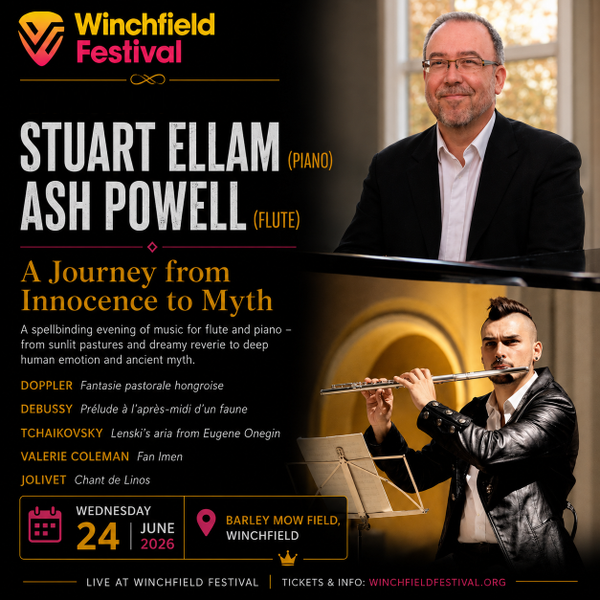
Ash Powell, flute · Stuart Ellam, piano
Frodsham, nr Liverpool · October 2023
Duo for flute and piano
Aaron Copland (1900–1990)
Flowing · Poetic, somewhat mournful · Lively, with bounce
Copland is the archetypal composer of American music. He wrote in varying styles, some based on folk music and some more avant garde. He found it more financially lucrative to stick to the former.
This piece was written in 1971 in his more accessible style, commissioned by a group of friends to commemorate the flautist William Kincaid.
"Lyricism seems to be built into the flute. The whole is a work of comparatively simple harmonic and melodic outline, direct in expression. Being aware that many of the flutists who were responsible for commissioning the piece would want to play it, I tried to make it grateful for the performer — it requires a good player."
— Aaron Copland
Let's hope we can find one.
Six Piano Pieces, Op. 118
Johannes Brahms (1833–1897)
Intermezzo: Allegro non assai, ma molto appassionato · Intermezzo: Andante teneramente · Ballade: Allegro energico
Written in 1893 and dedicated to Clara Schumann, these short pieces are Brahms' penultimate piano work. They are emotional and rather introspective, and they are some of his best loved music. Best played through the wall to your neighbours in the bath. The emotional content is so concentrated and intense that playing them feels rather like walking a tightrope.
Sonata for flute and piano
Paul Hindemith (1895–1963)
Heiter bewegt · Sehr langsam · Sehr lebhaft
Hindemith wrote this sonata in Berlin in 1936. He was later classified a "musical degenerate" by the Nazis, and the first performance was banned by the regime. It ends with a sardonic march which almost constitutes a fourth movement.
The second movement in particular reminds me of Shostakovich — a commentary on war which ends with a rather sarcastic exposition of a military march.
It is incredibly popular with exam boards.
Interval
Sonatine, Op. 76
Darius Milhaud (1892–1974)
Tendre · Souple · Clair
Milhaud is annoying. He was a prolific composer who used jazz and Brazilian idioms and also the dreaded — by me — polytonality. His projects ranged from the bizarre (Le boeuf sur le toit) to the grandiose (La création du monde). Among his students were Burt Bacharach, Steve Reich, Dave Brubeck, Philip Glass, Karlheinz Stockhausen and Iannis Xenakis.
Why annoying? His music manages to be superficial and interesting at the same time. Hideously complex while sounding simple. Written casually and quickly, yet minutely precise.
This piece is all of those things. The piano writing is cruel and uncomfortable, the flute mainly serene. Rhythms are never the same the second time. And, sadly, polytonality — which accounts for the general feeling that each hand at the piano and the flute are all playing in different keys.
They are.
Six Piano Pieces, Op. 118
Johannes Brahms
Intermezzo: Allegretto un poco agitato · Romance: Andante — Allegretto grazioso · Intermezzo: Andante, largo e mesto
Le Merle Noir
Olivier Messiaen (1908–1992)
Messiaen was a synaesthetic musical genius of profound and eclectic spirituality. His music is sincere and incredibly moving. He doesn't rely on compositional gimmick — see Milhaud — but instead builds a complex new musical grammar to express his inner life. Reading Messiaen is like learning to read music from scratch.
Le Merle Noir (1952) is the first of his pieces based on birdsong, a consuming lifelong passion which culminated in the two Catalogues d'oiseaux. It is only five minutes long and demands extreme virtuosity from the flautist.
I told my piano teacher we were playing this. He said: "You're made of sterner stuff than me. I used to get annoyed with Merle Noir, partly because I thought the real life thing was more beautiful, and partly because it didn't seem to make a huge difference if the two players got out of sync, which is easy to do."
Takes all sorts, I suppose.