Classical Meets Fetish — Folsom Europe, Berlin

A week before the concert, the soprano sadly had to withdraw.
That is survivable. You lose some repertoire, redistribute what's left, and tell yourself the programme is tighter for it. Everyone who has ever put on a concert has done this. Nobody enjoys it.
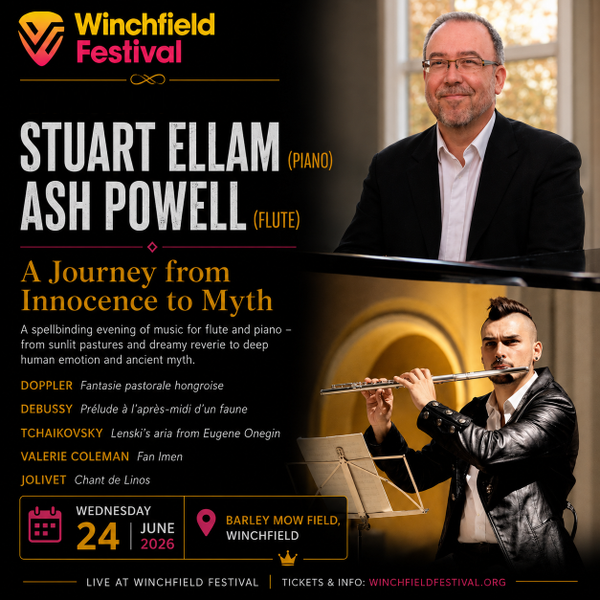
The day before the concert, we lost one of our flautists.
That took out the Doppler — our duo, and a piece the evening had been built around — and left a second hole in a programme that had already lost one.
What the soprano was going to sing
Two things. A Tchaikovsky duet with the tenor — Minula strast, No. 5 of the Six Duets, Op. 46: passion spent. And Marietta's Lied from Die tote Stadt.
The duet simply went. There is no version of a duet for one.
The Korngold did something better than that. Marietta's Lied is Glück, das mir verblieb, sung near the beginning of the opera by a woman who is alive. The finale is the same music at the end of it, sung by Paul, after she has gone. Losing the soprano didn't take the song out of the programme — it moved it to the version where it is being remembered rather than sung.
That wasn't a decision. It was the only way to keep the piece. It was also the right one.
What the tenor did
He took it entirely in his stride, and he took on more. Three substantial things at a day's notice:
Lensky's aria from Tchaikovsky's Eugene Onegin — the one before the duel, where a young man decides in advance how to feel about dying.
Danilo's song from Lehár's Die lustige Witwe — the opposite in every respect, and exactly the right thing to put next to it.
The finale of Korngold's Die tote Stadt — a man finally letting go of someone he has lost.
Any one of those at that notice would be respectable. Three, without appearing to find it difficult, is a complete professional.
It also meant three accompaniments to be got ready inside the same twenty-four hours, which is the part of these arrangements nobody thinks about until they are in it. I had played Lensky's aria before. The Lehár and the Korngold I had not. Learning two accompaniments in a day isn't heroic — people do it — but the Korngold is a reduction of a very full orchestral texture and it does not sit comfortably under the hands.
What I added
After the Korngold I put in Liszt's transcription of Schubert's Ständchen.
It was a perfect transition, in key and in mood.
The Korngold ends in B♭ major; the Liszt begins in D minor. D is the third of that final B♭ chord — the note still sitting in the ear becomes the new tonic — and the two key signatures differ by a single flat. Almost nothing moves, and the colour changes entirely.
The Korngold finale is a man letting go of someone he has lost, and it resolves gently. The Schubert goes on calling into the night regardless — leise flehen meine Lieder, softly my songs plead through the night to you.
One lets go. The other keeps asking.
Everyone else
The rest of the programme went ahead as written, and went well. Flute and harp were in the Korngold and in a good deal besides, and worked hard for it. There were other wind players, and piano and organ where the music asked for them.
A programme that has been rebuilt twice in eight days tends to make everyone on it more careful rather than less.
How it went
We knew the new programme had worked at the end of the concert. The audience stood — for all of the musicians, which was right, because by then it had taken all of them.